

A landfill gas well underperforms when it can't move gas from the waste into the header at the quality the site needs. The cause is almost always one of three things: the well is physically compromised, the vacuum isn't right for it, or conditions change between measurement rounds and nobody sees it in time.
The gap is bigger than most people expect. When the Environment Agency measured methane collection efficiency at four UK landfills, results ranged from 52% to 99%, and the lowest was at the site whose collection system wasn't working properly (Environment Agency, 2026). Landfill gas is lost at every stage of production, and a lot of it starts at the well.
To see where things go wrong, it helps to know what a working well does. Gas enters through the well screen (the slots in the well pipe), and vacuum from the plant pulls it up to the wellhead. From there it flows into the header, the main pipe that carries gas to the plant.

What does an underperforming landfill gas well look like?
Low flow, oxygen creeping up, methane dropping, and readings that won't hold still from one round to the next. Each symptom points to a short list of likely causes.
Based on the troubleshooting guide in Waste360 and the US EPA LMOP handbook, chapter 8.
Why do landfill gas wells underperform?
The table points to a long list of likely causes. Underneath, they fall into three groups: the well itself is compromised, the vacuum on it is wrong, or conditions change between measurement rounds.
The well is physically compromised
Liquid in the well. Leachate and condensate collect in the well and cover the slots in the well pipe, so gas can't get in. Landfill engineers call this a watered-in well. Pumping the liquid out of the landfill is still the most common fix (Waste360).
Clogged well screens. Fine particles and bacterial growth slowly clog the gravel pack and the perforations. Flow drops over months, not overnight (Waste360).
Settlement. Waste compresses and breaks down, so the ground sinks unevenly over the years. Pipes lose their slope and well pipes get squeezed. Where the header sinks, it forms a low point, and water that condenses out of the gas collects there. Once that low point fills up, it blocks the pipe and can cut vacuum to a whole section of the field (SCS Engineers).
The vacuum is wrong for the well
Too much. Over-pulling draws air in through the cover or a leaking seal. Oxygen in the waste slows the bacteria that make methane, and it raises the risk of a fire below the surface (US EPA).
In the wrong place. In an unbalanced field, some wells are starved while others pull air. The total vacuum can look fine while half the wells underperform.
Pulling in two directions. An engine or upgrading plant wants steady gas quality. Cutting vacuum to protect quality can leave methane in the waste (Waga Energy). Good tuning balances the two. It is never just a matter of pulling harder.
Conditions change between measurement rounds
Barometric pressure. Falling air pressure draws more gas out of the waste; rising pressure holds it in. At one US landfill, emissions swung up to 35-fold day to day (Xu et al., LI-COR and Bluff Road Landfill); in Denmark, recovered gas followed barometric pressure closely (DTU). That is why the Hydryx dashboard shows a forecast of barometric pressure.
Neighbouring wells. Wells on the same header share one vacuum. Opening one valve changes the suction pressure at the wells around it, so tuning one well can quietly change another. The US EPA treats drops in vacuum from well to well along a header as a warning sign in its own right (US EPA LMOP handbook, chapter 8).
Time between rounds. Wellfield monitoring is typically done weekly to monthly, depending on the site (US EPA LMOP). Changes in between go unseen until the next visit, so the well wasn't badly tuned: it was tuned for conditions that constantly change.
How do you find out which problem a well has?
Several causes produce the same symptom, so one reading rarely tells you which you have. Look at trends and comparisons instead. Six checks narrow most problems down.
- Trend each well over time. A slow decline in flow or a slow rise in temperature tells you more than any one reading. Check for seasonal patterns.
- Compare wellhead vacuum with header vacuum. High vacuum at the well with little or no flow usually means the well is watered in.
- Trace vacuum along the header. If vacuum drops from well to well, follow it back towards the plant to find the blockage or the sag.
- Measure the liquid level against the perforated depth. Compare it with the well's as-built drawing to see how much of the well screen is under liquid.
- Read oxygen and nitrogen together. Air carries about four parts nitrogen to one part oxygen, so both rising together means air is getting in. Oxygen at the wellhead must not exceed 5%.
- Treat rising temperature or carbon monoxide as urgent. Both can signal heating below the surface.
These checks tell you where to look. The limits and the actions that follow, such as when a well is closed in, belong in your site's gas management plan. (US EPA LMOP handbook, chapter 8.)
What does fixing an underperforming well actually involve?
It depends on the cause. Physical problems need physical work. Balancing problems need better measurement and control.
Software doesn't unblock a flooded well. A pump does. Once the field is physically sound, balancing it is what keeps it performing.
Where continuous monitoring and automated tuning fit
Automated tuning handles the balancing problems. Continuous data also makes the physical ones easier to catch early.
Good technicians tune wells well. The limit is frequency, because a change in conditions can quickly change how much gas your wells extract, and trip your generator. We wrote about that gap in: Landfill gas wells change by the day.
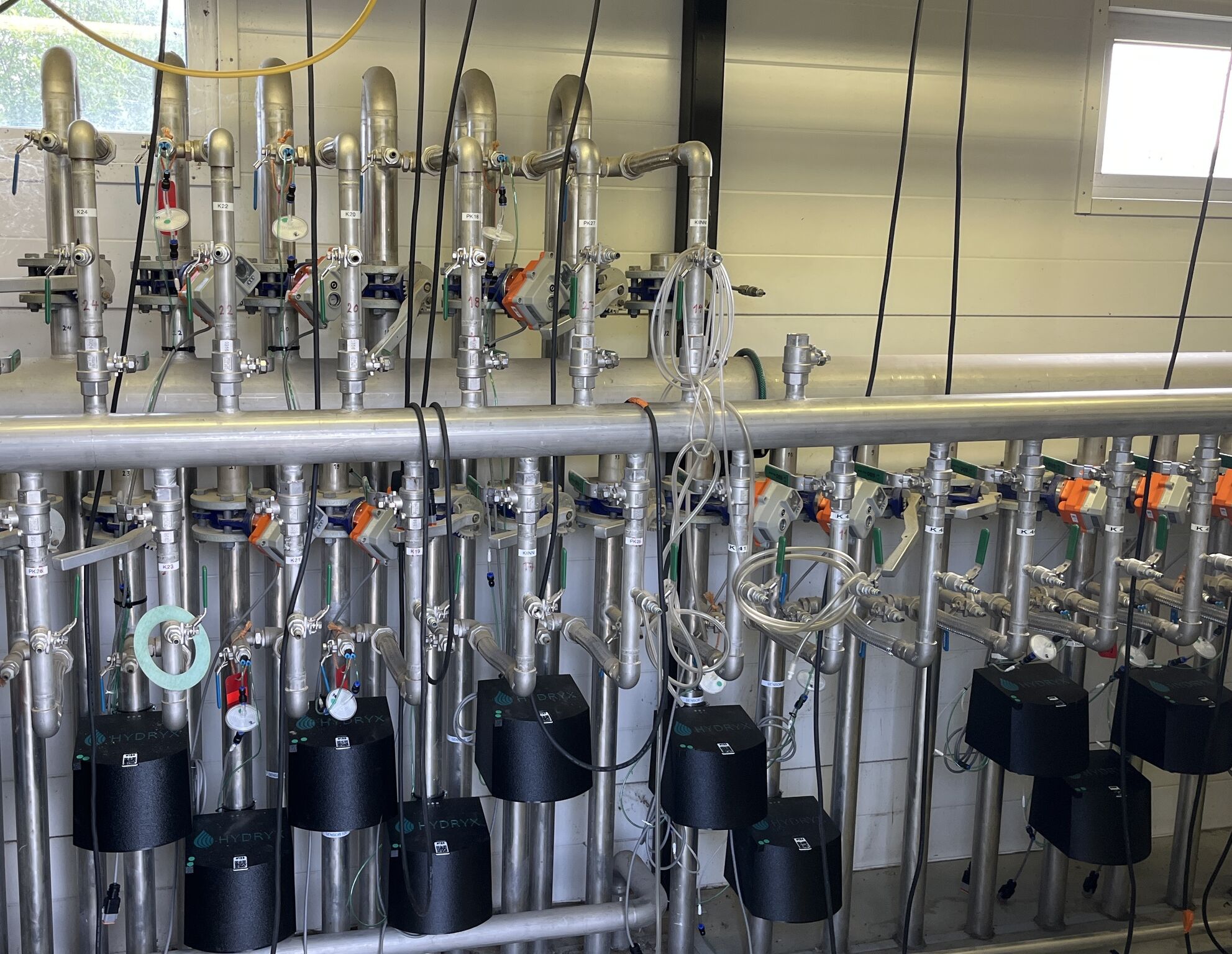
Hydryx clips sensors and actuators onto a site's existing wellheads. Methane, oxygen and pressure are sampled at every well every 15 minutes. A model trained on that site's own data then sets each valve position, within hard limits the landfill engineer defines.
On live sites in the Netherlands, Finland and the UK, that adds up to more than 30% green energy uplift and 90% less time spent on well tuning. The Assessment is free, installation needs no civil works or permits, and there is no upfront investment. See how it works.
Frequently asked questions
How often should landfill gas wells be tuned?
It depends on the site. Manual rounds typically run weekly to monthly, and sites feeding an energy plant tend to tune more often (Waste360). UK permit guidance asks operators to monitor and adjust the collection system continuously. Automated tuning makes that literal: every valve is reviewed every 15 minutes.
What oxygen level is too high in a landfill gas well?
Normally oxygen must not exceed 5% by volume at the wellhead or in the collection pipework, unless there is a site-specific justification. Your gas management plan sets the control levels below that (Environment Agency). Oxygen and nitrogen rising together means air is getting in.
Can you collect more landfill gas without drilling new wells?
Often, yes. Gas production, barometric pressure and the suction pressure from wells change all the time, so a well tuned on Monday can be wrong by Thursday. Continuous tuning keeps every well matched to the conditions around it, so each one draws as much landfill gas as it can without pulling in air. On live Hydryx sites that adds up to more than 30% green energy uplift from the wells already there. Flooded or blocked wells still need a pump or a repair first.
Does applying more vacuum increase landfill gas collection?
Only up to a point. Past it, the well pulls in air, gas quality drops, and the risk of a fire below the surface rises. In an open cell with only temporary cover, air gets in even more easily, so the safe margin is smaller. On a flooded well, more vacuum can even draw more liquid in. The gains come from setting the right vacuum for each well, not more on all of them.
Estimate your site's potential
Tell us about your wellfield and we'll show what continuous well tuning could add. Estimate your site's potential.